
Better Living
The Suburban Initiative

🎶 You’ve got to eliminate the negative, latch on to the affirmative 🎶
A new world is coming, one drop at a time
The officer didn’t look me in the eye. He looked at the inside of my wrist and then consulted a fan of cards he kept in his breast pocket. He slid one labeled 464 against my arm, nodding sharply.
“Mark him as 464-Alpha and schedule him for the HD Drop Test,” he muttered to the medic. “Let’s see if he can hold the reagent better than the 440s and 450s.”
They didn’t call me by my name after that. I was a living swatch being prepped for a new coat of paint and shipped off to be part of what they called the Suburban Initiative. They marked a circle on my forearm in permanent violet ink and dripped three drops of a clear, heavy oil into the center. It didn’t burn. It actually felt cold. A deep, sickening cold that belonged in the bottom of a well.
“Report to the Initiative, 464-Alpha,” he said, flashing a startling smile of synthetic white. “Consider yourself a pioneer of a very bright future.”
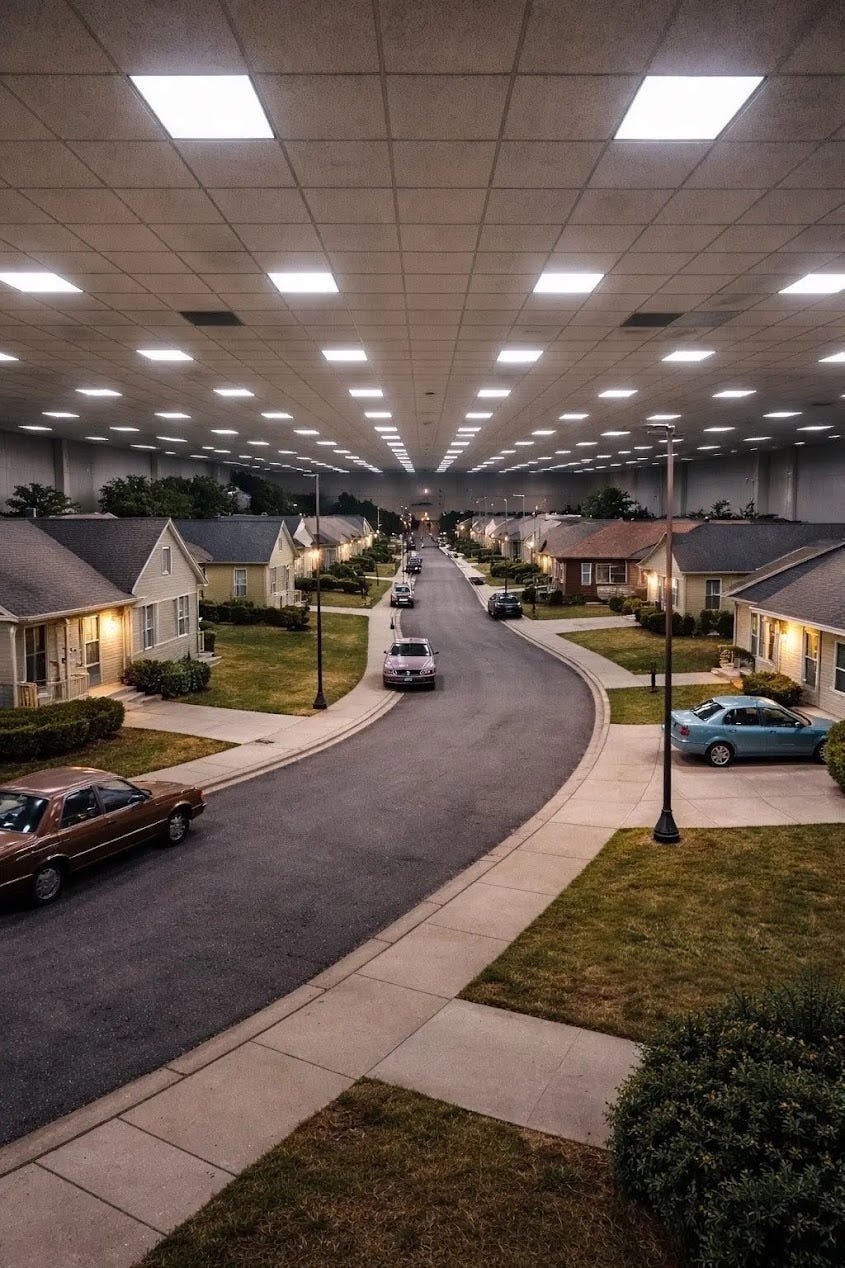
They drove us to a… neighborhood, I guess, for lack of a better word. It felt like it had just been unpacked from a crate that morning. A grid of duplexes sat on a flattened patch of dirt, everything painted in a subdued palette of colors with names like Manifest Destiny Mint and Postwar Primrose. The light was the best part. At least that’s what they told us, but I didn’t trust it. It wasn’t sun. It felt pressurized. A yellow glare that stayed constant from 0600 to 1800 hours, as if the government had bought the sky and installed a dimmer switch to ensure no unapproved shadows survived.
The first few days, my whole body seemed to hold its breath. I walked the concrete paths with the other ‘high potential candidates.’ Other young servicemen like me, whose dark skin had been mapped by the soot of motor pools and the grease of supply lines. The men who labored in the galleys or hauled heavy crates in the night. The ones never meant for the recruitment posters. We weren’t invisible here. They called us patriots. We all stood on our identical porches, looking at our circles, waiting for the war to happen to us. They said it was refinement.
Then, the purple vein started crawling. It started out thin like a sewing thread. Eventually I could feel throbbing while my own pulse tried to catch up. With every heartbeat, the line seemed to stretch wider as it wound its way up my forearm.
I noticed the neighbors changing first.
Arthur was a young guy from Georgia. He was always talking about the red clay of home and the flowering dogwoods and wild ginger he helped his grandfather care for as a kid. I noticed him standing on the pavement near his duplex at noon. He was staring at a vacuum cleaner advertisement in a magazine with a look of religious ecstasy. The purple vein had reached his throat, wrapping around his neck like a royal cravat of pure progress.
Wait, why did I think that? I don’t even know what a cravat is. I know the grit of a heavy engine and the smell of diesel, but I don’t know what progress looks like.
“Arthur?” I called out.
He turned fast. His hollow eyes glinted like plated chrome. “The neighborhood is very efficient, don’t you think, 464-Alpha? I’ve decided I need a second toaster. A man isn’t a man without a backup to ensure total consistency.”
He didn’t sound like Georgia anymore. His voice seemed far away and detached, like a radio announcer selling luxury soap. He sounded like he’d been scrubbed with lye until all that was warm about Arthur was gone. Replaced. By a terrifying flat beige that was so aggressively neutral, it felt like a scream.
By the end of the week, the change spread even further. The neighborhood had become a bizarrely choreographed stage play. My friend Sal, who used to swear in three languages, was now meticulously clipping his grass with a pair of silver scissors. While he snipped, he hummed the tune of a steady march in a flawless, soulless baritone. He didn’t look at me, but I could feel his agitation anytime I was near. To him, I was just a smudge in the scenery. It seemed like no one could really see me anymore.
Somewhere deep, even I was starting to despise the look of me.
Because the special assignment wasn’t about the reagent. It was just the delivery system for the Dream. They were testing how much of us had to burn away before we became the ideal citizens. It would adjust our static, so we could tune into the proper frequency.
Wait…that’s not right. A man is not a radio. But, it felt like someone was twisting a dial in my brain. Turning down the noise of my life until all that was left was a single note.
On Sunday, I sat on my porch watching the neighbors sweeping nonexistent debris from their driveways into the empty street. The purple vein was at my shoulder now. It felt like a hot wire, soldering my memories shut. I tried to picture my father’s face, but all I could see was the sleek, aerodynamic curve of that Ford Super Deluxe they were talking about making. The one that would ‘start the world again.’ I tried to remember the smell of my mother’s kitchen, but the mild scent of Spic and Span was more…correct.
Yes. This was better. Modern. Streamlined.
The vein reached my collarbone. It felt like a zipper closing me into a brand new suit.
Across the street, a technician in a pristine lab coat stood on the sidewalk, checking a stopwatch. He looked at me, then at his clipboard. He didn’t see a soldier. He saw a nearly successful integration.
“Looking sharp, 464,” he called out, his voice oily and encouraging. “Just let it reach the heart. You’ll find the world so much more available then.”
I looked down at my arm. The purple line was humming now, like a tube warming up deep inside a television set. It moved like a determined brass-pronged plug headed for its socket in the center of my chest. I wanted to scream, but my throat felt like it was being lined with velvet and ad space. I looked at the cookie cutter duplexes and, for the first time, I didn’t see an experiment.
I saw a bargain.
I stood up, my back straightening into that military posture I’d never quite mastered until now. My mind filled with a haunting, lovely broadcast I hadn’t heard yet. It was soft and white, like the industry had polished it until it shone.
The vein touched my heart and something clicked.
The glare of the sky didn’t hurt my eyes anymore. It was glorious. It was the brightest thing I had ever seen. I looked at the man in the lab coat and smiled wide, teeth gleaming like a fresh picket fence.
“Sir,” I said, my voice deep, confident, and impeccably manufactured. “I believe I’m ready for my new refrigerator now.”
I didn’t even wait for a response. I turned and walked into my identical house, whistling that song:
🎶 You got to spread joy up to the maximum, bring gloom down to the minimum 🎶
The light bleeding into the living room highlighted the spotless new carpets perfectly.

This was an interesting one to write in response to Labyrinthia Mythweaver’s weekly prompt. I actually grew up in a tiny duplex in a square-mile of government-made low cost veteran housing that was built after WWII that looked eerily similar to this image. My grandpa served in the Navy and moved into the neighborhood after the war. I wrote a nonfiction piece about some of the stories he shared with me, which heavily inspired this flash fiction. He was one of the servicemen the U.S. military used in their (then) secret mustard gas trials.1 Maybe I will share the nonfiction piece one day.
The song I reference in the story is “Ac-Cent-Tchu-Ate the Positive” (1944) performed by Bing Crosby and The Andrews Sisters (though the Ella or Aretha versions are better, in my opinion).2
For a quick article on the secret mustard gas trials, you can listen to an NPR story here. More and more details have been emerging about the trials so there is a lot more literature about it now. Always happy to recommend more.
You can hear the Bing version here, which is the one I had in mind for this story. It was a super popular song apparently, so many different artists performed it at some point or another.
Thanks for being here.
Until next time,
j

That was a trip. Please write for Black Mirror.
This is fabulous. Rod Serling would have been SO pleased to introduce this to the audience.